Leveraging Accounting Software to Improve Profit Margins in Construction: An Accountant’s Blueprint
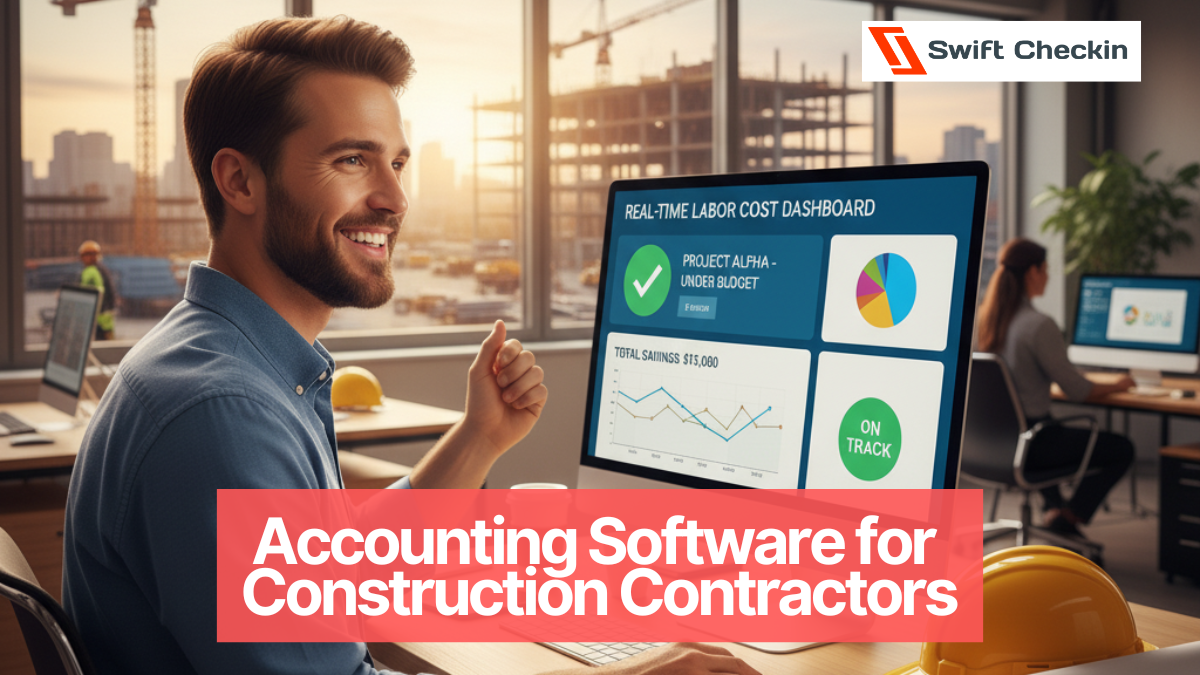
For the construction accountant or financial manager, the project site often feels like a distant, chaotic entity. Money is spent at the speed of construction, yet corresponding financial data trickles back to the office slowly. That information is marred by inaccuracies and significant delays.
The firm’s primary accounting software is its financial engine. It processes invoices, manages the general ledger, and ensures compliance. Yet, its true power remains suppressed by this persistent data gap.
The critical insight is this: accounting software for construction contractors cannot defend profit by itself. It must be actively fed clean, real-time data from the field. When properly integrated, the software transforms from a mere compliance tool into a powerful lever for proactive profit management.
The Accountant’s Reality: Trauma of Manual Labour Data
The financial integrity of any construction firm is tested most severely in the weekly management of labour costs. The accountant's typical workflow, burdened by archaic field processes, is characterised by unnecessary risk and administrative waste.
1. The Financial Blind Spot
Field data like timesheets, job codes, material receipts usually arrives days, even a week, too late. The accountant, responsible for generating current P&L and managing cash flow, constantly looks through a rear-view mirror. This financial latency allows cost overruns to compound silently. The accountant’s reports become a post-mortem analysis, never a living strategic guide.
2. Reconciliation Hell
The weekly grind means processing stacks of paper or illegible spreadsheets. An inordinate amount of time goes into chasing supervisor approvals, correcting miscoded activities, and manually inputting hours. This high-touch, error-prone reconciliation is a staggering waste. It diverts highly paid accounting resources from crucial work, like forecasting and strategic analysis.
3. The Burdened Rate Nightmare
An accountant must ensure regulatory compliance. This involves applying complex Award rules (like distinguishing between 1.5x and 2.0x rates). It also means accurately calculating the burdened rate (including Workers’ Compensation, Superannuation, and Payroll Tax) for every hour worked. Manually tracking these cascading costs across multiple jobs takes time. It exposes the firm to significant compliance fines and audit risk.
The Integration Imperative: Connecting Field to the General Ledger
To overcome these structural inefficiencies, the accounting system must establish a direct, automated bridge with field operations. This is where advanced integration with purpose-built timekeeping solutions demonstrates its indispensable value.
Auto-Timesheeting: Transforming Payroll Efficiency
Automated data transfer provides the most immediate relief. A field application transmits time data directly to the accounting platform, where hours are instantly validated and coded. This auto-timesheeting capability eliminates all manual entry and reconciliation. The weekly payroll cycle shrinks from days of tedious cross-checking to minutes of supervisor-approved sign-off. Staff are now free to focus on critical financial analysis, not clerical triage.
Real-Time Job Cost Feeds
The core benefit for job cost accounting is the immediate transfer of verified labour costs. Imagine a foreman's crew clocks out using a verifiable, site-aware tool—Swift Checkin. That precise, geofence-validated labour cost is synced with the accounting software like Xero in one-click.
This integration transforms the accountant’s role:
- From Scorekeeper to Partner: The accountant can now generate daily or even hourly reports showing actual labour spend versus budget by job code. They become a proactive financial partner, identifying and alerting the project management team to variances before the budget line is irrevocably breached.
- Accurate WIP and Revenue Recognition: Timely and accurate data improves the integrity of Work-in-Progress (WIP) reports and revenue recognition calculations. These are essential for banks, sureties, and financial statements. They provide a more transparent and defensible picture of the firm's financial health.
Compliance Shield and Burdened Rate Automation
The integration ensures time data arriving in the accounting system is already compliance-assured. The timekeeping application, pre-configured with award rules, has calculated the correct ordinary, overtime, and premium portions. The accounting software then automatically applies the necessary burdened rates (Payroll Tax, etc.). This drastically reduces the risk of payroll errors. It ensures statutory compliance while providing the most accurate, all-in cost for every hour worked.
Achieving Financial Foresight: Beyond the Balance Sheet
By leveraging powerful integrations, accounting software extends its utility far beyond basic compliance. It becomes the foundational layer for predictive financial control:
- Cash Flow Visibility: Precise, rapid processing of payroll allows for more accurate and timely cash flow forecasting. The accountant can project upcoming payroll obligations with confidence. This improves liquidity management and reduces reliance on overdrafts or credit.
- Predictive Variance Analysis: Real-time cost data enables truly predictive variance analysis. The accountant can now flag projects where the Cost Performance Index (CPI) trends negatively. This happens early enough for site management to intervene with scheduling or staffing adjustments. Consequently, the planned profit margin is preserved.
- Better Auditing and Documentation: All time records, approval stamps, and location verification data are digitally stored and linked within the financial records. This creates an unassailable, easily accessible audit trail.
Conclusion: The Mandate for Integration
For the construction accountant, the era of wrestling with incomplete field data must end. The capacity of your accounting software for construction contractors to safeguard margins and drive business growth is directly proportionate to the quality and timeliness of the data you feed it. By embracing seamless integration, you are not just automating a process; you are installing a necessary financial firewall.
The solution is unequivocal when the accountant demands that field operations utilize tools guaranteeing data integrity at the source. Implementing a system built around a verifiable, site-aware process like Swift Checkin delivers clean, coded, and costed data directly to the ledger.
This single integration transforms the accounting department from a high-risk processor of historical data into the indispensable source of real-time financial foresight that the entire organization relies upon to secure profitability.



