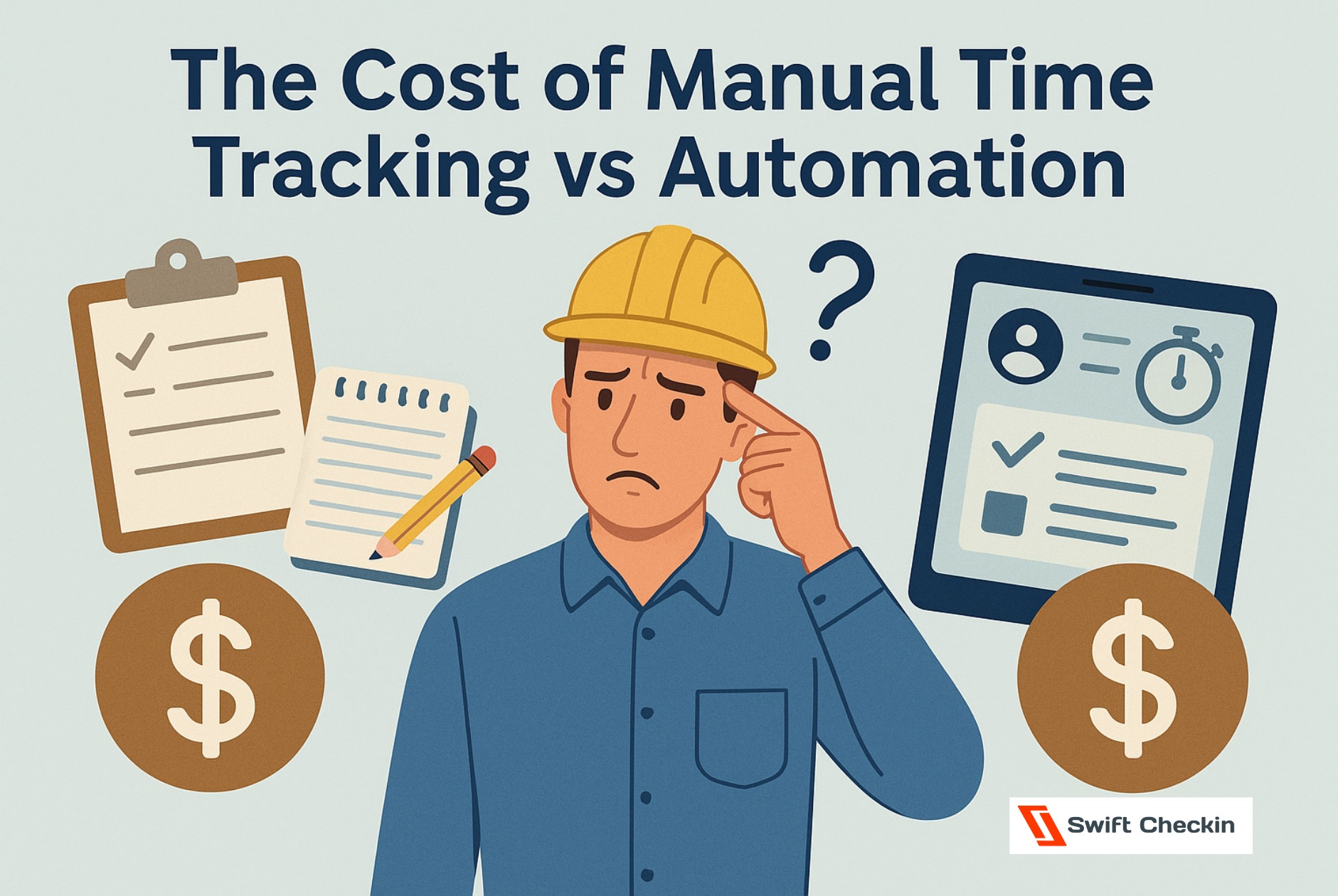
It's Friday afternoon, and your project manager is buried under a mountain of crumpled timesheets and WhatsApp groups on the phone. Half are illegible, three are missing, and two are not sure which project they belong to. Meanwhile, your crew is waiting for payday, and you're staring at a payroll deadline that's creeping closer by the hour.
If this sounds familiar, you're not alone. Manual time tracking is silently bleeding construction companies dry. Most small- to medium-sized companies don't realize how much it's actually costing them.
The American Payroll Association reports that manual time-tracking errors cost the average company 1-8% of their total payroll. In construction, where labor typically represents 40-50% of project costs, that's a massive hit to your bottom line.
But here's what's really eye-opening: when you add up all the hidden costs (administrative time, payroll errors, compliance risks, and lost productivity), manual time tracking often costs more than the technology needed to replace it.
Let's break down the real numbers.
Manual time tracking doesn't just affect payroll—it consumes valuable hours across your entire operation.
Here is a weekly time investment by role for a mid-sized contractor with 50 employees:
That's $28,860 per year just in administrative time for manual timesheet processing alone. Scale that up to larger operations, and the numbers become staggering.
Manual calculations are prone to mistakes. Even small errors compound quickly:
Common Manual Tracking Errors:
Annual error cost: $22,770 in direct financial impact along. Factor in the time spent identifying and correcting these errors, and the real cost doubles.
Buddy punching is a problem in itself, which can be eliminated with digital time tracking tools. Here is a detailed outing on the impact of buddy punching and how it can be fixed.
Manual systems create audit nightmares. Missing documentation can trigger:
One major compliance issue can cost more than a decade of automated time-tracking software.
Let's examine two construction companies with identical operations—one using manual tracking, the other automated.
Which means the automated system pays for itself in just 5 weeks.
Manual time tracking can eat up 30 hours a week just for paperwork and corrections. After automation, that drops to about 4 hours total. That’s over 1,200 hours freed up every year—hours that can go back into managing projects, not chasing signatures.
With manual systems, payroll mistakes hit nearly 1 in 7 timesheets and “buddy punching” can quietly drain thousands a year. Automation slashes errors to less than 1% and eliminates time theft, saving roughly $50,000 annually for a mid-sized contractor.
When you can see labor costs in real time, you catch overruns before they spiral. Automated tracking has been shown to boost project profit margins by nearly 3%. For a contractor with $12 million in revenue, that’s an extra $348,000 that doesn’t slip through the cracks.
Paper records are easy to lose and even easier to get wrong. Manual tracking puts you at a 1 in 4 risk of a Department of Labor violation, but automation cuts that risk to almost zero. The result? Nearly $50,000 a year saved in fines, penalties, and legal headaches.
Automation isn’t just about speed. It’s about putting money, time, and peace of mind back into your business.
Let’s talk about what it actually takes to get up and running with a time tracking system—and where the real differences show up.
Most time-tracking tools charge you for every single employee, usually somewhere between $8 and $15 per person, every month. For a crew of 75, that adds up fast. Swift Checkin flips the script with a flat fee, no matter how many people are on your payroll.
Other systems love their gadgets—tablets on every site, biometric scanners at every entry point. That’s $300 to $600 a pop for tablets and another $400 to $800 each for biometric readers. Swift Checkin skips the hardware circus entirely. Your team already has everything they need: their own phones and a QR code posted at the job site. No boxes to unbox, no tech headaches, no hidden costs.
Some of the big-name project management tools hit you with a bill just to get started—setup and configuration can range from $5,000 to $15,000, and then they’ll charge extra for training sessions. Swift Checkin? There’s nothing to install, no complicated onboarding, and if anyone does need help, training is free and quick enough to fit in a coffee break.
In short you’re not paying for bells and whistles you don’t need with Swift Checkin. You’re getting a tool that’s ready to go, right out of the box for a flat fee
The payback usually happens at the 9-month mark for the first year and at the 3-month mark for the following years.
Based on our 75-employee example:
Day 1: The payment is done, and you're handed the credentials. Training modules are available for everyone to access.
Day 2: Admin sets up projects, and workers can start using the tool
End of month 1: 0 payroll errors, 0 buddy punching, and 0 timesheet hassles. There you flipped the script, and Swift Checkin paid for itself.
Manual time tracking in construction isn't just inefficient, it's expensive. The hidden costs of administrative time, payroll errors, compliance risks, and lost productivity add up to hundreds of thousands of dollars annually.
Automation pays for itself quickly while delivering ongoing benefits:
The question isn't whether you can afford to automate. It's whether you can afford not to. Ready to stop losing money to manual time tracking? Sooner you start, the sooner you'll see the savings.
