Preventing Construction Cost Escalation with Real-Time Data: The Real-Time Cost Overrun Defence
In construction, the most damaging financial event is not a budget overrun. It is the surprise of a budget overrun. Projects often appear stable on paper, only to be hit with a sudden, overwhelming realisation of cost escalation weeks or even months after the damage occurred. This lag between the field performing the work and the finance team reporting the cost is where profit margins vanish.
Construction cost escalation is rarely a single catastrophic event. It is the slow, silent accumulation of daily inefficiencies of unverified overtime, inaccurate cost codes, and misallocated crew hours. The only mechanism capable of neutralising this threat is the implementation of real-time data tracking. By using modern timekeeping software, contractors transform their oversight from passive auditing into aggressive, predictive control.
The Anatomy of Silent Cost Escalation
To understand how real-time data prevents budget shock, we must acknowledge the three primary sources of concealed cost accumulation:
1. The Lagging Indicator Trap
Traditional job costing relies on weekly or bi-weekly timesheet approvals and subsequent data entry into the accounting system. By the time a project manager receives a report showing a cost code is 20% over budget, the inefficient activity or process has already run for 10 to 14 days. The issue isn't fixed until after the damage is done, guaranteeing a large, non-recoverable escalation.
2. Scope Creep Disguised as Labour
When field teams perform minor, unapproved tasks without proper documentation (scope creep), they inevitably log the hours against existing, legitimate cost codes. This practice artificially inflates a productive budget line, making the efficient work appear costly, and simultaneously hides the true cost of the unapproved change. This distortion in the construction labour cost is a stealth bomber targeting profitability.
3. Mismanaged Contingencies
Contingency budgets are designed for unforeseen risks, not predictable inefficiencies. Without precise real-time data, project managers often treat the contingency as a buffer to cover labour overruns caused by poor planning or faulty execution. This premature depletion of the safety net leaves the project exposed to genuine, future risk, guaranteeing a costly escalation when the real problem eventually hits.
Real-Time Tracking: The Proactive Defence Strategy
Real-time timekeeping and tracking software disrupts the traditional cost cycle by collapsing the time lag between work performed and cost recorded. This immediate visibility is the cornerstone of proactive cost overrun prevention.
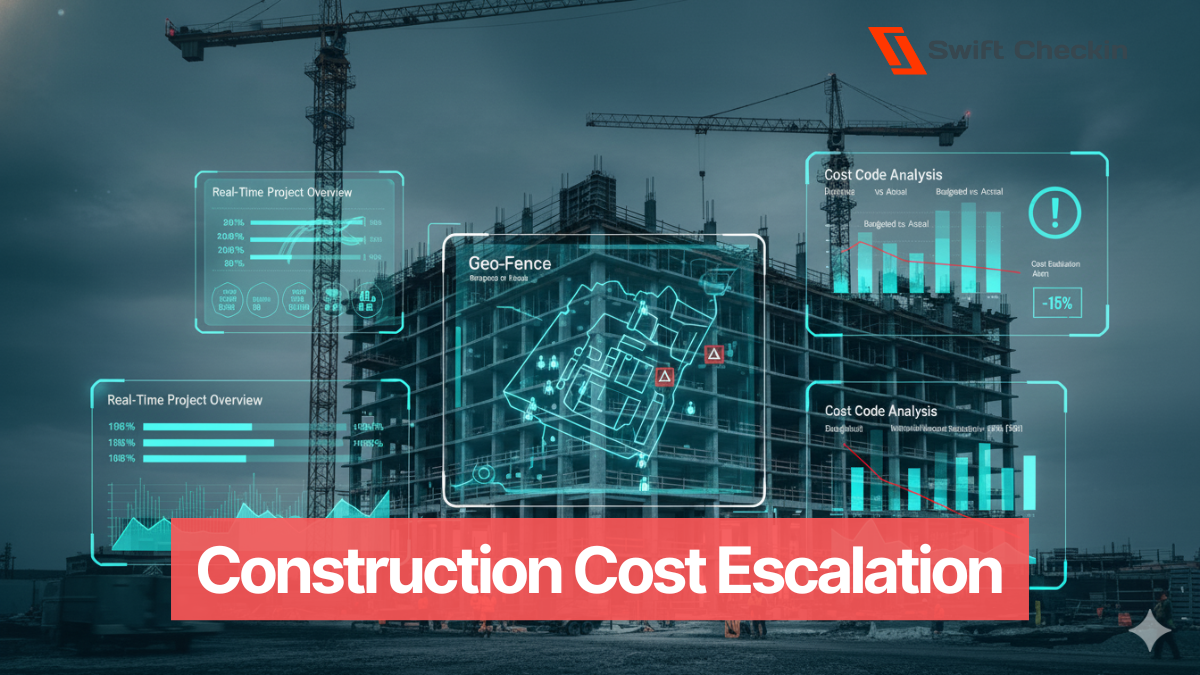
1. Geo-Fencing and Instant Deviation Alerts
Modern software utilises mobile devices and geo-fencing to instantly verify crew location and log time to the minute. More crucially, the system is programmed with budget thresholds for every work activity.
If a crew logs 10 hours against a cost code that was budgeted for 7 hours, the system generates an immediate, geo-verified alert to the project manager. The PM is then empowered to investigate the cause—Is it crew inefficiency? A site constraint? A materials delay?—and take corrective action that same day. This prevents a minor daily deviation from becoming a massive weekly escalation.
If a Project Manager stops a four-person crew from working an unapproved 2 hours of overtime each day for a week, at a $40 base rate, the system avoids 40 hours of premium pay ($800) that would have otherwise led to an unnecessary budget shock.
2. Enforced Cost Code Granularity
Real-time platforms require workers to log hours against specific, mandatory cost code allocations linked directly to the Estimate At Completion (EAC). This eliminates the vague logging that disguises scope creep.
By enforcing mandatory granularity, the system ensures that every hour is accurately categorized. This instant, clean data feed allows the financial system to track the Estimate At Completion (EAC) with unprecedented accuracy. Project managers can confidently forecast the project's financial trajectory, turning potential future escalations into manageable present-day decisions.
3. Data-Driven Crew Optimization
When real-time data shows that one crew consistently completes a specific task 15% faster than another, that information is immediately actionable. Project managers can use the system to redeploy high-performing crews to high-risk areas or restructure the deployment schedule to maximise efficiency across the entire site. This optimization of human resources directly reduces the time and effort required to meet milestones, serving as a powerful buffer against construction cost escalation.
Conclusion: Data Velocity is Profit Protection
The failure to manage cost is a failure of information velocity. Relying on financial data that is days or weeks old guarantees that you are always managing yesterday's budget problems. Construction cost escalation only happens when cost accumulation is hidden.
The shift to a real-time tracking model, connecting the field with financial performance, is the definitive defence. It transforms financial reporting from a historical document into a predictive alert system. By making compliance and accurate logging as simple as a Swift Checkin, you ensure the data is reliable, immediate, and actionable, preventing the creeping costs that threaten the profitability of every fixed-price contract.



