Construction scheduling is the backbone of every successful project. Your ability to plan, coordinate, and execute tasks on time determines whether your project finishes on budget and on schedule.
We’ve all seen it. The tile guys show up before the plumbing’s done. A crane gets booked two days after the beam it needs to lift. Someone forgot that concrete doesn’t pour itself over a holiday weekend.
These aren’t bad crews. They’re just flying blind. And it costs them BIG TIME. Time is money in construction.
Good construction scheduling isn’t about fancy software or perfect charts. It’s about making the work doable, predictable and smoother for everyone.
Construction scheduling is the process of planning and organizing all the tasks, resources, and timelines needed to complete a construction project from start to finish.
At its core, construction scheduling is: what happens, when, and why it matters.
It’s your plan to get from blueprint to handover without losing your shirt. You take the entire build—foundations, frames, finishes—and break it into tasks that people can actually follow.
But here’s the thing no one says enough: a schedule only works if it works for the field. If it’s too rigid, too confusing, or made only for the boardroom? It’ll get ignored.
The best schedules feel like a daily rhythm—not a spreadsheet that requires decoding skills.
A 2024 Construction Management Association of America report found that projects with solid construction scheduling are 68% more likely to hit deadlines and 53% more likely to stay under budget.
A 2023 PMI survey adds weight: 92% of large-scale projects using robust project scheduling management finished within 10% of their planned timeline, while those without lagged behind by an average of 27 days.
The numbers don’t lie. Skimp on scheduling, and it’s like building a house on sand—things collapse fast.
Construction scheduling isn’t just for the project manager. It requires a multi-level collaborative approach of effective application. Construction project scheduling is non-negotiable, especially for complex builds like bridges and hospitals.
A 2024 Dodge Construction Network study noted that 78% of mega projects using dedicated project scheduling software avoided major delays, compared to just 43% relying on manual methods.
A killer schedule changes the game on-site:
Before diving into scheduling techniques, you need to understand the typical phases of a construction project. Each phase has its own scheduling considerations and challenges.
You don’t pour concrete on Day One. The real work starts long before that. During pre-construction, you'll develop your master schedule, identify long-lead items, and establish your project baseline. Key activities include:
The best schedulers spot problems now, before they snowball.
Here’s where your schedule meet reality. The hard hitting reality. Because no site on earth is wonderland to go exactly as planned. Rain delays, a missing part or labour shortage the list goes on.
This is where look-ahead schedules shine. The 2-to-6-week views that help you see what’s coming and make adjustments without blowing up the whole project.
It’s also where crews need clarity.
Here’s where most teams relax too early. But this is make or break for client satisfaction.
Punch lists -> Final inspections -> Fixes -> Clean-up -> Closeout.
You’d think this would be quick. But without a plan, post-construction drags on for weeks.
Not all construction schedules are created equal. Different project types, sizes, and complexities require different scheduling approaches.
The big-picture view, packed with major milestones and phases. Think of it as the 30,000-foot view that helps stakeholders understand the big picture.
This is your working schedule. It breaks down each phase into specific tasks, shows dependencies, and includes resource assignments. This is what your foremen and crews use to understand what needs to happen each day.
Usually covering 2-6 weeks, look-ahead schedules help you identify upcoming constraints and coordination needs. They're essential for proactive problem-solving and resource planning.
These weekly or daily schedules focus on immediate tasks and are often used for crew coordination and daily planning meetings.
A cost loaded construction schedule is your project plan with the price tags attached. That way, you’re tracking progress and spending too. It’s like having a map that tells you both the route and the fuel costs, so you always know where your money is going as the project moves forward.
Used in 85% of large projects (PMI 2023), the Critical Path Method is the gold standard for construction scheduling. It identifies the longest sequence of dependent tasks that determines your project's shortest possible duration—your critical path. Delay these tasks, and the whole project slips. It’s the laser focus for project scheduling management.
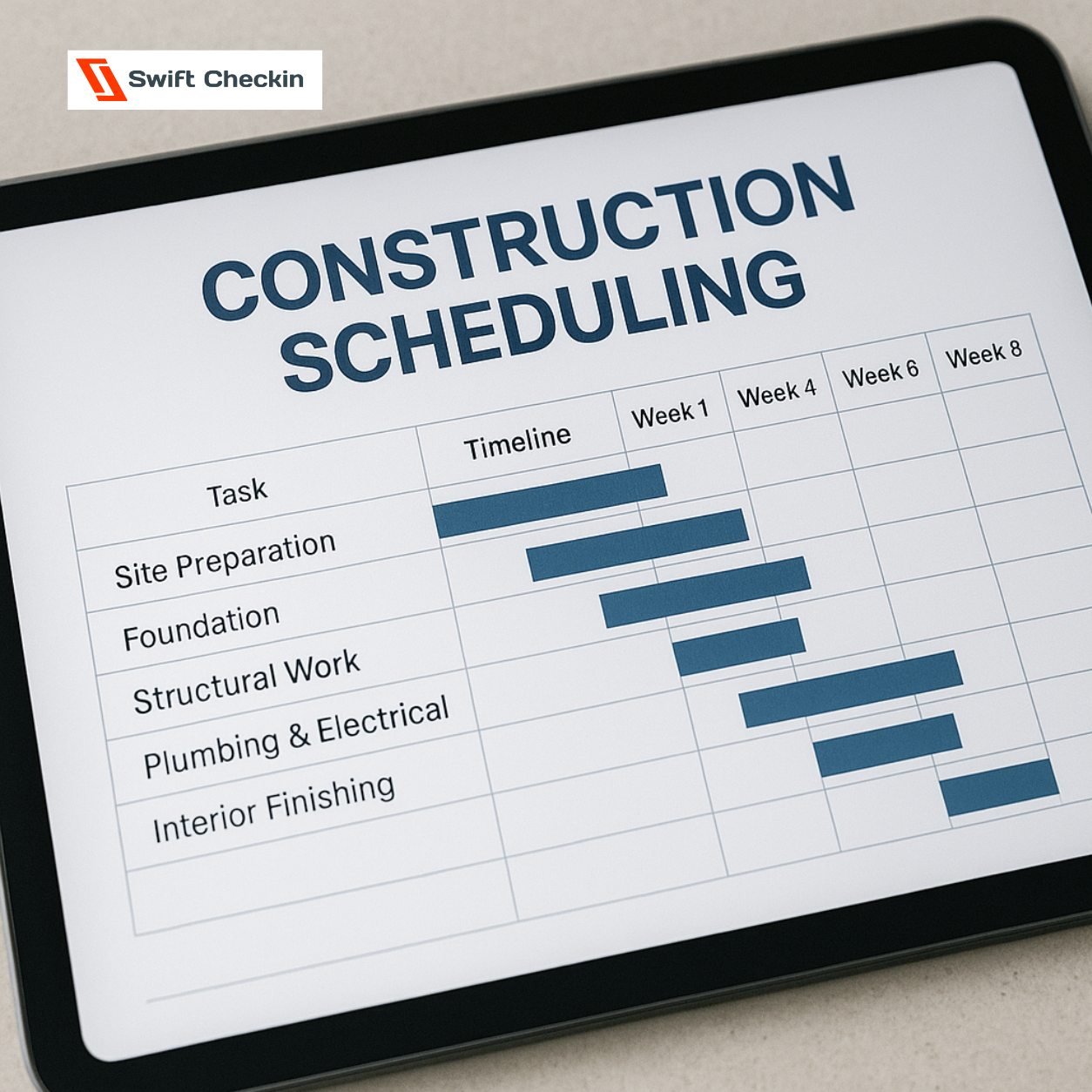
Gantt charts turn schedules into eye-catching visuals, with tasks as horizontal bars across a timeline. They're incredibly useful for communicating schedule information to teams and clients.
The Last Planner System is a collaborative approach that involves the "last planners" (foremen, supervisors) in the scheduling process. It focuses on making work flow predictable and reliable.
Start by breaking your project into major phases, then into smaller work packages, and finally into individual activities. This Work Breakdown Structure (WBS) forms the foundation of your schedule.
Tips for Effective Breakdown:
Determine the logical order of activities and identify dependencies. Ask yourself: "What must be completed before this activity can start?"
Common Dependency Types:
Estimate how long each activity will take. This requires experience, historical data, and realistic assessment of productivity rates.
Factors Affecting Duration:
Assign the necessary resources (labor, equipment, materials) to each activity. This helps identify potential conflicts and ensures you have what you need when you need it.
Look for opportunities to compress your schedule without compromising quality or safety. This might involve:
A schedule isn’t just about control. It’s about creating predictability in an unpredictable environment.
Paper schedules and Excel are holding teams back. They get lost, are hard to update, and mean lots of phone calls just to keep everyone in the loop.
Switching to project scheduling software makes life easier:
A recent survey showed that 62% of construction teams waste hours every week tracking down updates or fixing mistakes from outdated schedules.
Another study found that projects using dedicated scheduling software finished 30% faster and with 25% fewer delays compared to those relying on old-school methods.
Most big-name scheduling tools are packed with features, but they’re so complex that field crews rarely use them. If it takes a manual and a training session just to check tomorrow’s tasks, adoption flops.
That’s why Swift Checkin keeps it simple. Built with real crews, it’s made for job sites, not just offices. You get smart scheduling, shift reminders, mobile check-ins, and real-time updates—all in one place, without the headache. No fuss. No confusion. Just a tool that fits the way you work.
Problems will happen—materials delayed, equipment breakdowns, unexpected weather.
Good schedules don’t prevent problems. But they give you a way to respond. You can reshuffle crews. Shift to interior work. Push non-critical tasks without ruining everything.
A rigid schedule breaks. A smart one flexes.
Schedules Don’t Build Projects. People Do. But schedules let people do it better.
If you’re managing a site you don’t need to be a scheduling guru. You just need a plan people can understand and follow on a platform that is easy to access and (more importantly) easy to understand for field workers.
Because in construction, timing isn’t everything. It’s the only thing.
